


The private aviation industry has spent decades making incremental improvements — better avionics, quieter cabins, longer range, more efficient engines. Otto Aerospace is attempting something different: a ground-up rethink of what a business jet should look like and how it should move through the air.
The result is the Otto Aerospace Phantom 3500.
Where It Comes From
Otto Aerospace — formerly known as Otto Aviation — is an American aerospace company that has spent years developing and validating laminar flow technology through a purpose-built demonstrator aircraft, the Celera 500L. The core insight driving their work is that conventional aircraft designs, with their cylindrical fuselages and wing-mounted engines, produce enormous amounts of aerodynamic drag. That drag is the primary reason business jets burn as much fuel as they do.
Laminar flow is the aerodynamic condition where air passes smoothly over a surface in parallel layers, producing dramatically less friction than the turbulent flow most aircraft experience at cruise. It’s been understood since the early days of aviation. The challenge has always been maintaining it across a full aircraft in real-world conditions.
Otto’s demonstrator validated that a full-aircraft laminar flow design was achievable. The Phantom 3500 is the production application of that work.
What Makes It Different

The Phantom 3500’s most immediately striking feature is its fuselage. Where conventional jets use a roughly cylindrical tube, the Phantom 3500 uses a teardrop-shaped body optimized for laminar flow — smooth, tapered, and aerodynamically unlike anything currently in production. The shape is functional, not stylistic.
The second thing most people notice: there are no windows.
This is a deliberate design decision, not an oversight. Windows create structural complications, require reinforcement, and introduce surface irregularities that disrupt laminar flow. The Phantom 3500 replaces them with high-resolution exterior cameras feeding digital displays that line the interior cabin walls. Passengers get a panoramic, real-time view of the world outside — arguably a better one than a standard oval porthole provides — without the aerodynamic and structural cost of cutting holes in the fuselage.
Powering the aircraft are two Williams FJ44 engines, each producing approximately 3,600 pounds of thrust. The Phantom 3500 is designed to remain under the FAA’s Part 23 maximum takeoff weight limit of 19,000 pounds, which significantly streamlines certification requirements compared to larger transport-category aircraft.
The performance targets are ambitious: a range of 3,500 nautical miles with up to nine passengers, at transonic cruise speeds that outpace most aircraft in its class — at a fraction of the fuel burn.
The Flexjet Deal and What It Signals
In September 2025, Flexjet — one of the world’s largest private aviation operators — announced an order for 300 Phantom 3500 aircraft. At market pricing, the deal is valued at approximately $5.85 billion.
Orders of this scale from operators of Flexjet’s standing don’t happen on a bet. They reflect a serious assessment of whether the technology works, whether the company can deliver, and whether the economics make sense at scale. For a fractional ownership operator whose business model depends on precise cost management, the Phantom 3500’s fuel efficiency story is commercially compelling.
The order also serves as a vote of confidence that the aircraft’s unusual design — windowless fuselage, unfamiliar silhouette, unconventional cabin experience — is something the market will accept. Flexjet has a sophisticated customer base. If they believe in the product, that matters.
Timeline and What Comes Next
The Phantom 3500 is still in development. Otto Aerospace is currently conducting wind tunnel tests of the aircraft’s low-drag design and targeting a first test flight in 2027. Type certification — through the FAA under Part 23 — is targeted for 2030, with customer deliveries beginning that year.
Construction of Otto Aerospace’s manufacturing facility at Cecil Airport in Jacksonville, Florida is underway, with the company investing significantly in building out its production infrastructure ahead of the certification push.
For buyers considering the aircraft, 2030 is the realistic entry point. A lot can happen between now and then — certification programs rarely run exactly to schedule, and a design as unconventional as the Phantom 3500 will face scrutiny throughout the process. That said, the demonstrator program de-risked the core technology more than most pre-certification programs, and the Flexjet order creates real commercial momentum.
What It Means for the Market
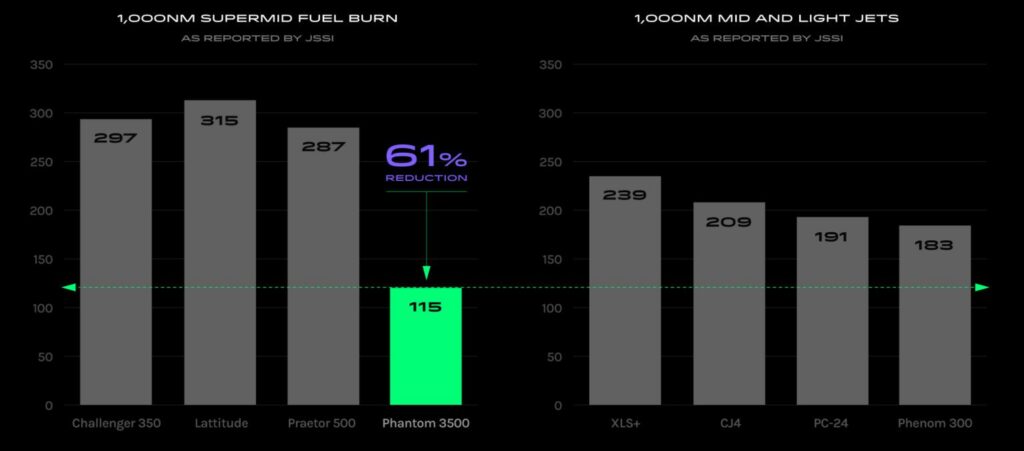
The Phantom 3500 sits in an interesting category. At 3,500 nautical miles of range with nine passengers, it competes with midsize and super-midsize jets on range while claiming operating economics closer to light jet territory. If the performance numbers hold through certification, it would represent a meaningful disruption to how operators think about the cost-range tradeoff.
It also introduces a cabin experience with no precedent in the market. The virtual window system, combined with a fuselage optimized for aerodynamic efficiency rather than legacy interior layout conventions, gives Embraer and Gulfstream design teams something genuinely new to think about.
Whether the windowless cabin becomes a competitive advantage or a barrier to adoption will depend entirely on how passengers respond to it in practice. The answer to that question won’t be known until the aircraft is flying commercially.
The Bottom Line
The Phantom 3500 is not vaporware. It has a validated technology foundation, a serious production order, and a manufacturer that has been methodically building toward this moment for years. It is also still four or more years from its first customer delivery, and unconventional enough that it carries real development risk.
For the private aviation industry, it represents something rare: a genuine attempt to rethink the physics of the problem rather than optimize around them.
That alone makes it worth watching.
Interested in understanding where the business jet market is headed — and what it means for buying or selling today? Holstein Aviation stays ahead of the market so our clients don’t have to. Contact us to talk through your aircraft plans.