
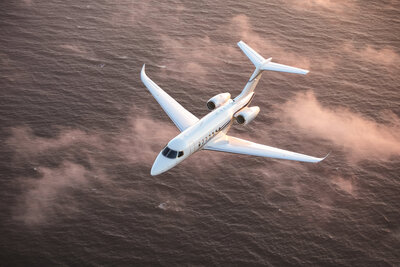
In February 2026, Embraer unveiled the first significant evolution of the Praetor family since its launch: the Embraer Praetor 500E and 600E. Both aircraft retain the airframes, engines, and flight systems that made the original Praetors compelling. What changed is almost entirely focused on the cabin — and the changes are substantial enough that buyers evaluating pre-owned Praetors against new-production options will want to understand exactly what they’re trading.
The Aircraft They Started With
Before getting into what’s new, it’s worth understanding what Embraer built on.
The Praetor 600 has been one of the most capable super-midsize jets on the market since its introduction. Powered by two Honeywell HTF7500E engines and equipped with full fly-by-wire flight controls — a feature that was genuinely class-leading when it launched — the 600 offers an intercontinental range of 4,018 nautical miles and can connect New York to London nonstop. For a super-midsize aircraft, that’s exceptional.
The Praetor 500 occupies the midsize segment, sharing the same fly-by-wire system and engine family, with a somewhat smaller cabin and a range of approximately 3,340 nautical miles. Together, the two platforms gave Embraer a competitive position across both categories.
The E variants don’t change any of that. The airframe, engines, and performance numbers carry over intact. What Embraer chose to invest in was the experience inside the aircraft.
What the “E” Actually Changes
The Smart Window (600E)
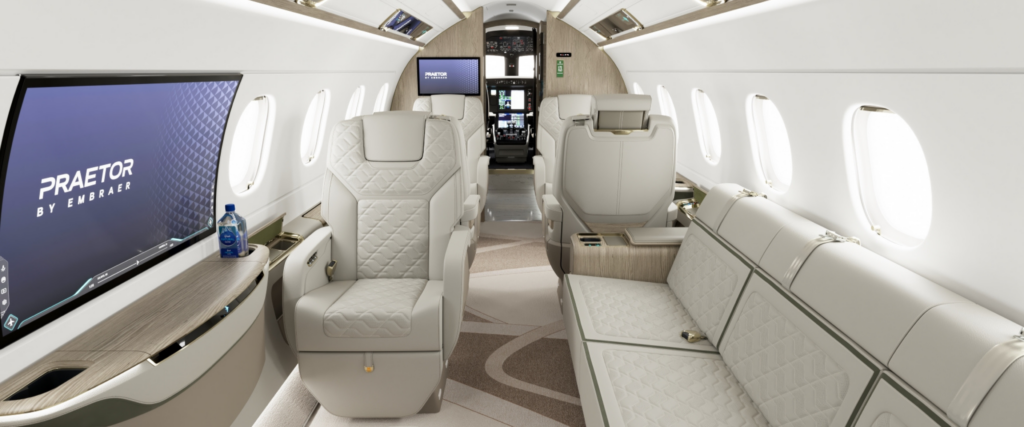
The most striking addition to the Praetor 600E is what Embraer calls the Smart Window: a 42-inch, 4K OLED touchscreen mounted in the cabin. It’s a multipurpose display capable of video conferencing, high-resolution entertainment streaming, and real-time exterior views fed from cameras mounted on the outside of the aircraft.
It’s a genuinely novel feature for a super-midsize cabin — and it signals where Embraer sees the competitive pressure coming from. Buyers in this segment increasingly expect technology parity with what they use on the ground, and a wall-mounted 4K display with conferencing capability addresses that expectation directly.
Redesigned Seating
Both the 500E and 600E get completely redesigned seats, manufactured in-house by Embraer. The new chairs include adjustable cushion firmness, dual lumbar support, a forward-tracking headrest that moves with the seatback angle, increased legroom, and an electric-assist recline mechanism. On long legs — transatlantic range is what the 600 is designed for — seat quality matters more than most buyers appreciate until they’re eight hours in.
Galley and Refreshment
The 600E’s galley has been redesigned to increase its capability for serving full meals on extended missions. The 500E gets a redesigned refreshment center with similar intent. Neither aircraft is trying to replicate a heavy-cabin catering setup, but the update is meaningful for operators running missions where a proper meal service matters.
Cabin Management System
Both aircraft get a fully redesigned Cabin Management System (CMS) that handles lighting, temperature, entertainment, and connectivity through a unified interface. Optional upgrades include voice command integration, Bluetooth audio throughout the cabin, wireless charging, and RGB mood lighting. The new system is substantially more intuitive than what it replaces and brings the Praetor cabin experience in line with what buyers have come to expect from recent large-cabin deliveries.
Safety Additions
Embraer added the Runway Overrun Awareness and Alerting System (ROAAS) to both aircraft as standard equipment. The system monitors approach and landing parameters and alerts the crew if runway overrun is a risk — reducing pilot workload during critical phases and improving safety margins at challenging airports.
Performance and Pricing
The E variants carry over the same Honeywell HTF7500E engines, fly-by-wire flight controls, and active turbulence reduction system from the existing Praetors. Range, payload, and performance numbers are unchanged.
The Praetor 600E is listed at $25.795 million — approximately 7–8% above the outgoing Praetor 600. For buyers weighing whether to pursue a new 600E versus a pre-owned Praetor 600, that premium buys a materially upgraded cabin, the Smart Window, and new-aircraft warranty coverage. Whether that delta is worth it depends almost entirely on how intensively the aircraft will be used and how much the cabin experience matters to the principal passengers.
Deliveries for both variants are scheduled to begin in Q1 2029.
What This Means for the Pre-Owned Market
Announcements like the 500E and 600E tend to have a predictable effect on pre-owned pricing for the preceding generation. In the near term — especially ahead of certification and as buyers place deposits on E-variant deliveries — sellers of current-generation Praetors may find their market slightly more competitive.
That’s not necessarily bad news for buyers. A well-equipped pre-owned Praetor 600 with strong maintenance history represents genuine value in the super-midsize category, with the same flight performance as the new aircraft at a lower acquisition cost. The cabin differences are real but addressable through interior refurbishment for buyers who prioritize performance per dollar.
For sellers of pre-owned Praetors, the calculus is different. The longer the wait before an E variant delivers, the more runway there is to transact at current values. Waiting too long as the market absorbs the E announcement carries its own pricing risk.
The Bigger Picture
The Praetor 500E and 600E are a clear statement from Embraer about where it sees competition in the midsize and super-midsize categories. The flight performance case for the Praetor has always been strong — fly-by-wire in a super-mid, intercontinental range without a fuel stop, competitive operating economics. The E update addresses the one area where the original aircraft drew criticism: a cabin experience that, while good, didn’t quite match the sophistication of the flight deck.
For buyers coming to market now, the calculus is straightforward: if you need an aircraft before 2029, the current Praetor remains one of the most capable options in its category. If your timeline allows, the E is a more compelling package.
Evaluating a Praetor 600, 600E, or alternatives in the super-midsize category? Holstein Aviation works with buyers to find the right aircraft for the mission — and the right deal for the moment. Contact us to start the conversation.