
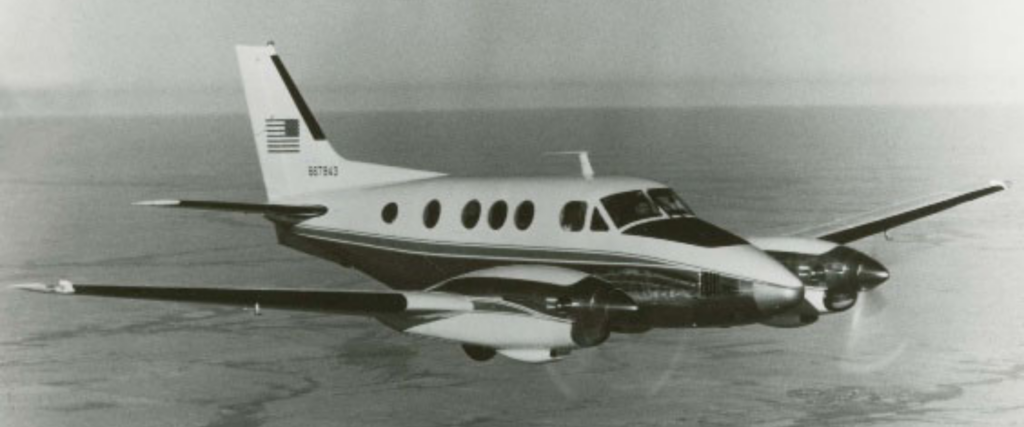
Most aircraft earn a place in aviation history with a single breakthrough moment. The Beechcraft King Air earned its place by simply refusing to stop. More than 60 years after its first flight, it is still in production today, still the best-selling business turboprop family in the world, and still the answer for owners who never needed jet speed in the first place. The story behind it starts with a company betting on the wrong engine, an engineering team that said no to the right one, and a company president who overruled her own staff to make it happen anyway.
The Piston Ceiling
By the early 1960s, business aviation was standing at the edge of a shift from piston power to turbine power, and everyone in the industry could feel it coming. The big, supercharged Lycoming engines flying in aircraft like Beechcraft’s own Queen Air had reached practical limits on horsepower. Beechcraft needed a turbine-powered answer, and it needed one that regular corporate buyers, not just airlines and the military, could actually afford to fly.
Beechcraft Bet on the Wrong Engine First
Beechcraft’s first move wasn’t the PT6. In 1961, company executives traveled to the Paris Air Salon and partnered with the French firm SFERMA to build a turboprop business aircraft around Turbomeca’s Astazou engines. That concept, the Model 120, was unveiled at the NBAA convention later that year with French power under the wings, not the Pratt & Whitney engine the King Air would eventually become famous for.
The Engineers Said No. The President Said Otherwise.
Separately that same year, Beech engineers sat down with United Aircraft of Canada (who would eventually rebrand as Pratt & Whitney Canada) president Thor Stephenson to look at a new turboprop the company had developed, the PT6A. The engineers turned it down. At roughly $15,000 per engine, it looked too expensive to pencil out.
Olive Ann Beech, the company’s co-founder and president, disagreed, and she made sure everyone knew it. According to the account preserved in King Air Magazine, she reportedly told her team:
“I don’t normally interfere with engineering or management decisions, but I still control this outfit. I’m telling you to take those engines, which are costing us nothing, and put them in the airframe. Just try it.”
That overruled decision, a founder’s gut call against her own engineering department, was one of the pivotal moments behind the King Air’s creation.
An Engine Looking for Its First Real Airplane
The PT6 had already flown once before Beechcraft touched it. On May 30, 1961, United Aircraft of Canada flight-tested the engine for the first time, mounted on a modified Beech 18 testbed at de Havilland Canada’s facility in Ontario. That flight proved the engine itself worked, but it wasn’t tied to any real aircraft program yet.
Proven at No Additional Cost to the Army
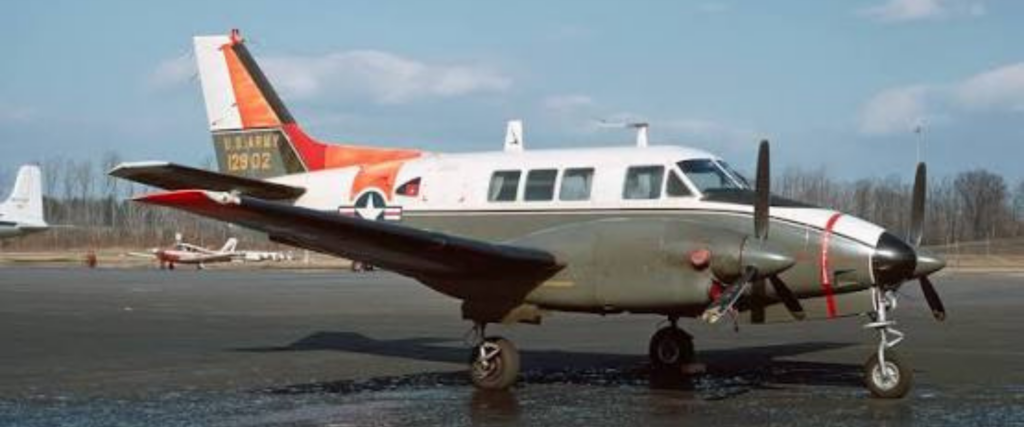
Beechcraft and United Aircraft of Canada didn’t have to gamble much to find out if Olive Ann Beech was right. The Army had already ordered and paid for the airframe itself, an existing Queen Air. Beechcraft and United Aircraft of Canada converted that airframe into a proof of concept called the NU-8F, with United Aircraft of Canada supplying the PT6A-6 engines at no additional cost to the Army. Ten months of testing beginning in May 1963 proved the concept worked, making that converted Queen Air the true bridge between an engine that had only ever flown as a test article and the airplane about to put it into production.
When the King Air entered service in 1964, it became the first production aircraft in the world flying with the PT6 installed.
From Announcement to Delivery in Under a Year
Once the PT6 was validated, Beechcraft moved fast:
- August 14, 1963: Beechcraft officially announces the Model 65-90 King Air, powered by the PT6A-6
- January 1964: First flight of the prototype
- May 19, 1964: FAA type certificate awarded
- July 7, 1964: First commercial delivery, fittingly to United Aircraft of Canada
Beechcraft accepted $10.8 million in orders within 90 days of announcing the King Air.
What the Original King Air Actually Delivered
AOPA’s own historical summary put it bluntly: the first Model 90 King Air was “basically a Queen Air with turboprops.” That was the whole point. Beechcraft didn’t reinvent the airframe, it married a proven, familiar cabin to a genuinely new kind of power:
- Twin United Aircraft of Canada PT6A-6 turboprops, rated at 550 shaft horsepower each for takeoff
- A pressurized cabin, a first for Beechcraft’s twin-engine business aircraft line
- Seating for 6 to 8 passengers plus crew
- Reliability and simplicity that reciprocating engines of the era could not match at that power level
Just as important as anything on the spec sheet was the price. The King Air undercut the only other pressurized turboprop option on the market at the time, the Grumman Gulfstream I, by a wide enough margin to open up an entirely new tier of buyer.
A Platform the Military Wanted Too
The King Air’s airframe proved just as useful in uniform as it did in the corporate hangar. The U.S. Navy ordered 61 examples as the T-44A Pegasus, used for decades to train multi-engine pilots. The Army flew U-21 variants for signals intelligence and battlefield surveillance. A VC-6A carried President Lyndon Johnson, and that aircraft is preserved today at the National Museum of the U.S. Air Force.
Still Being Built Today
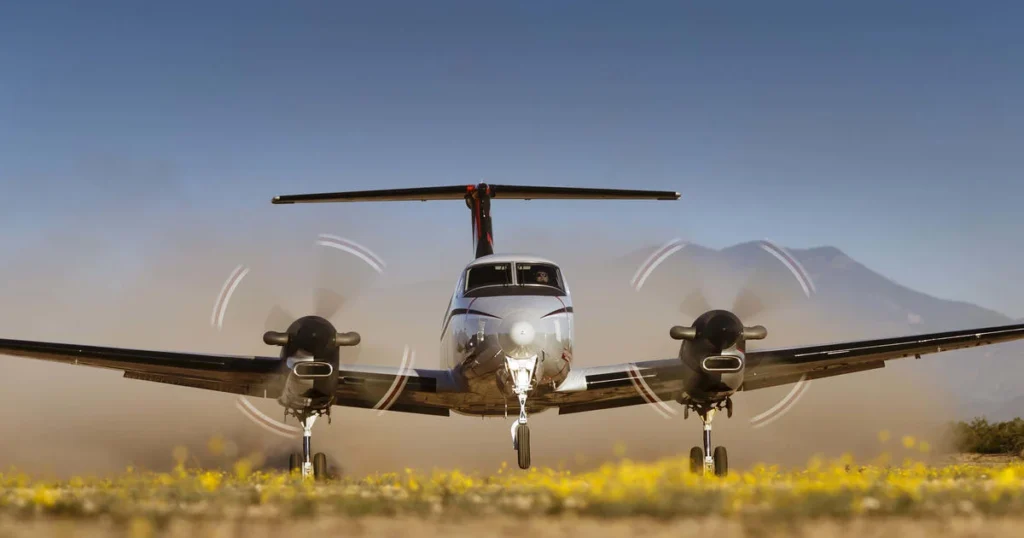
Unlike most of its contemporaries, the King Air’s story never really ends. The original 90-series line, evolved over the decades into the C90GTx, ran for 57 consecutive years before Textron Aviation, Beechcraft’s successor, finally retired it in 2021. The King Air family kept going regardless. Textron builds three variants today, the King Air 260, 360, and 360ER, carrying the same pressurized cabin and turbine reliability into the modern era.
Across the full family, more than 7,900 King Airs have been delivered since 1964, with the worldwide fleet logging more than 66 million flight hours, according to figures reported in April 2026. No other business turboprop, and few business aircraft of any kind, come close to that combination of volume and longevity.
Why It Still Matters
The King Air proved something the rest of the industry didn’t fully believe yet in 1964: a huge share of the business aviation market didn’t want jet speed at all. What owners actually wanted was a pressurized cabin, twin-engine reliability, and lower operating costs than a jet, delivered in an airframe simple enough to fly and maintain without a large flight department. Every cabin-class turboprop built since has to answer to the standard the King Air set, and six decades later, Beechcraft is still building the airplane that answered it first.
Contact Holstein Aviation to talk through where today’s business aircraft came from, and where the market is headed next.