
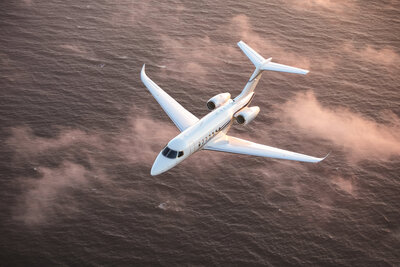

Bombardier announced on September 10, 2026 that its Global 8000, the fastest civil aircraft since Concorde, has received U.K. Civil Aviation Authority (CAA) approval to land at London City Airport. The Bombardier Global 8000 London City Airport clearance takes effect immediately, opening one of the most restrictive business aviation airports in the world to the largest aircraft in Bombardier’s lineup.
Why London City Airport Is a Hard Airport to Get Into
London City sits inside a densely populated part of east London, and it operates under strict noise-abatement rules along with one of the shortest runways used by any business jet destination in Europe. Those two constraints have made London City highly selective about which aircraft can operate there, and every aircraft type needs its own individual clearance to fly the approach. With this announcement, the Global 8000 now joins a short list of aircraft cleared to operate in and out of London City, one that, until now, left operators of the type landing instead at Farnborough or Luton and completing the trip into the city by car.
The specific numbers explain why. London City’s single runway measures just 4,948 feet, short enough on its own to rule out most large-cabin jets. On top of that, every arrival has to fly a 5.5 degree glideslope on approach, nearly double the standard 3.0 degree approach used at almost every other airport in the world. That steep descent exists mainly to clear obstacles, most notably the Canary Wharf skyline that sits along the western approach path, with the added benefit of keeping aircraft higher for longer over surrounding neighborhoods to reduce noise. The approach demands both special aircraft certification and special aircrew training to fly safely.
What the Global 8000 Can Do From Here
With CAA approval in hand, Global 8000 operators can now fly directly into London City rather than routing through an outlying airport. Bombardier says the change can save passengers 60 to 90 minutes of ground transfer time getting into London’s financial district, since London City sits far closer to the City of London and Canary Wharf than either alternative. U.K. CAA approval alone doesn’t clear every Global 8000 to fly the approach, though: the aircraft’s operator also needs the steep-approach supplement approved by the civil aviation authority in its own country of registration before it can use it.
The approval also extends the aircraft’s usable network into London City itself. Bombardier points to nonstop city pairs from Singapore, Los Angeles, Honolulu, and Buenos Aires now open to Global 8000 operators flying into the airport.
The Aircraft Behind the Approval
The Global 8000 entered service in December 2025 after a certification run that included Transport Canada in November 2025, the FAA in December 2025, and EASA in January 2026. Its headline numbers:
- Top speed of Mach 0.95, the fastest of any civil aircraft since Concorde
- Range of 8,000 nautical miles
- Cabin altitude of 2,691 feet at 41,000 feet, the lowest in business aviation production today
- Access to up to 30 percent more airports than its nearest competitor, according to Bombardier
Stephen McCullough, Bombardier’s Executive Vice President of Engineering and Product Development, credited the aircraft’s wing design for making the London City approach work, calling the clearance further proof of the Global 8000’s engineering.
Where the Global 8000 Sits in the Market
The Global 8000 is the flagship of Bombardier’s Global family, sitting above the Global 7500 on both speed and range, with its 8,000 nautical mile range, the figure that gives the aircraft its name, extending about 300 nm beyond the 7500’s published 7,700 nm. That combination puts it in direct competition with Gulfstream’s own flagship, the G800, in the small but closely watched ultra-long-range segment where manufacturers compete as much on range and speed records as they do on cabin size. Airport access approvals like this one are becoming part of that same competition, since an aircraft that can legally reach more city-center airports offers a real operational advantage that a spec sheet alone does not capture.
Ready to Talk Through What This Means for Your Next Trip?
Airport access like this is exactly the kind of detail that separates aircraft on paper from aircraft that actually fit your mission. If you’re weighing range, cabin, or where an aircraft can and can’t take you, the team at Holstein Aviation can walk through the specifics with you.
Sources: