

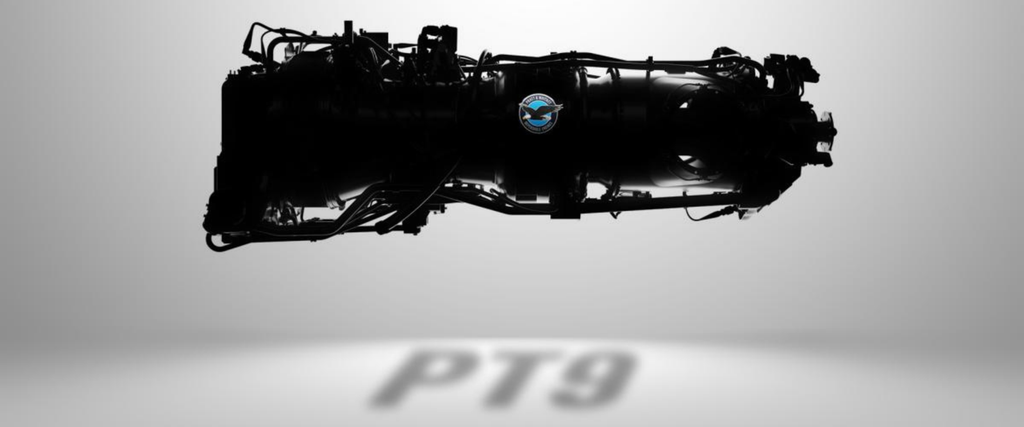
Pratt & Whitney Canada surprised the industry at NBAA-BACE in Las Vegas this week. On October 21, 2026, the company unveiled the Pratt & Whitney Canada PT9, an all-new turboprop engine in the roughly 2,000 shaft horsepower class. The bigger surprise was that the engine arrived already certified. Transport Canada approved it on October 1, after a development program that P&WC kept quiet for about five years.
For anyone who owns, flies, or is shopping for a turboprop, this is worth paying attention to. Here is what the PT9 is, what P&WC is claiming, and what it does and does not mean for the aircraft flying today.
What the PT9 Is
The PT9 is a clean-sheet engine, which means it is not a stretched or updated version of an existing design. P&WC has described it as its first all-new turboprop in decades.
The key facts released so far:
- Power class: Roughly 2,000 shp, with P&WC targeting a range of about 1,700 to 2,300 shp depending on the application
- Certification: Approved by Transport Canada on October 1, 2026
- Testing: More than 14,000 development hours across 12 test engines
- Layout: A centerline engine with a reverse-flow combustor and a slim 19-inch “barrel” section designed for low-drag installation
- Production: Assembly at P&WC’s facility in Lethbridge, Alberta, which is also the company’s global center of excellence for the PT6 family
P&WC President Satheeshkumar Kumarasingam called the PT9 “the next evolution of turboprop propulsion.”
The Performance Claims
P&WC is making two headline claims compared with current engines in the same class:
- 33% more power at altitude
- 20% lower fuel consumption
Power at altitude is the number that matters most for a turboprop that wants to compete with light jets. Turboprops are efficient, but they traditionally give up speed and climb performance up high. An engine that holds more of its power at cruise altitude helps close that gap.
The 20% fuel burn improvement is just as important for operating costs. Fuel is one of the largest variable expenses in any aircraft budget, so a meaningful drop in burn shows up directly in cost per hour.
These are manufacturer claims. Real-world numbers will depend on which airframe the engine goes into and how that aircraft is designed around it.
What Is Different Under the Cowling
According to Aviation Week’s reporting from the unveiling, the PT9 borrows materials and technology from two other P&WC engines, the PW800 turbofan (used on aircraft like the Gulfstream G500 and G600) and the PW127XT regional turboprop. A few design points stand out:
- Fewer life-limited parts: P&WC says this should reduce maintenance costs over the life of the engine.
- Harder, stiffer alloys and additively manufactured parts: Modern materials that P&WC expects to improve durability.
- Engine health monitoring: A sensor system that tracks more than 300 parameters, building on the digital engine and propeller controls introduced with the PT6 E-Series.
- Modular, scalable design: P&WC says the architecture leaves room for growth and can be tailored to different airframes, including possible hybrid-electric integration in the future.
P&WC has not yet published maintenance intervals or time between overhaul figures. Those numbers will be some of the most important details for operators once an aircraft is announced.
No Aircraft Announced Yet
The PT9 is certified, but it does not have a confirmed home. P&WC has not named a launch customer or a specific aircraft.
Kumarasingam said the company is “pretty confident of signing one or two customers,” and estimated about 18 months to serial production depending on customer engagement. P&WC says the target market is new-generation single and twin-engine turboprops.
That means the first PT9-powered aircraft is still several years away. An airframer would need to announce a program, design or adapt the aircraft around the engine, and complete its own certification before deliveries could begin.
What This Means for the PT6
For most turboprop owners, this is the most practical question. The PT6 powers a huge share of the business turboprop fleet, including the Pilatus PC-12, the Beechcraft King Air family, and the Daher TBM series.
P&WC was direct on this point. The PT9 is not a replacement for the PT6. Kumarasingam said, “We still feel that the PT6 has many years ahead of it.”
The PT9 is positioned to fill the gap between the largest PT6 variants and the lower end of the PW100 series used on regional turboprops. For owners of PT6-powered aircraft, that means:
- Support for your engine is not going away. P&WC is clearly still investing in the PT6 family.
- Your aircraft’s value is not suddenly threatened. A new engine with no airframe yet does not change the market for aircraft flying today.
- The long-term picture is getting more competitive. GE Aerospace’s Catalyst engine, which powers the upcoming Beechcraft Denali, already competes in this space, and the PT9 is widely seen as P&WC’s answer.
Why It Matters for Buyers
Engine choices shape an aircraft’s operating costs, maintenance planning, and resale value for decades. A new engine family entering the market is an early signal of where turboprop design is heading: more power up high, lower fuel burn, and more digital monitoring.
For buyers in the market today, the PT9 is not a reason to wait. Proven PT6-powered aircraft have deep support networks, well-understood maintenance programs, and established resale markets. For buyers planning their next aircraft several years out, it is a program worth tracking as airframe announcements come.
What to Watch Next
- The first airframer to announce a PT9-powered aircraft
- Published maintenance intervals and time between overhaul figures
- FAA validation of the Transport Canada certification
- How the PT9 and GE’s Catalyst compete for new turboprop programs
Thinking About a Turboprop?
Whether you are weighing a proven PT6-powered aircraft like a King Air, PC-12, or TBM, or planning around what is coming next, the engine decision matters as much as the airframe. The team at Holstein Aviation can help you compare what is available now, what it costs to operate, and how it is likely to hold its value.