
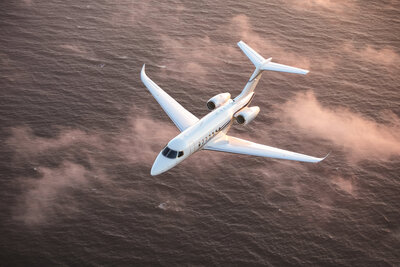
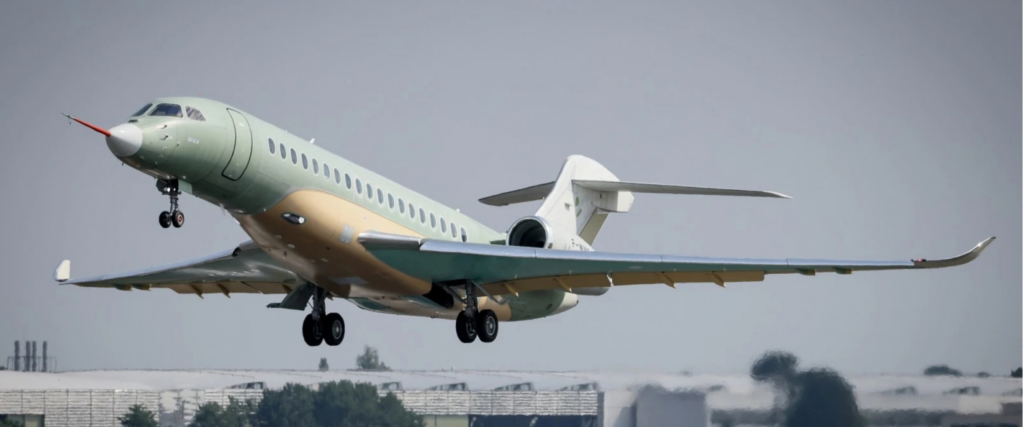
Dassault’s flagship Falcon 10X now has two aircraft in its flight test program. The second test airframe made its first flight in late September 2026, roughly three months after the first prototype flew on June 19, and by early October it had already logged three flights. Alongside the progress update came a new timeline: Dassault now expects the Falcon 10X to enter service in 2029. Here is where the program stands and what has changed since it was first announced.
Two Aircraft Now Flying
The first Falcon 10X took to the air on June 19, 2026, closing out a ground test effort that ran for roughly five years before the aircraft ever left the runway. That flight started the formal certification campaign.
The second test aircraft, serial number 2 and registered F-WTEN, joined the program in late September. According to Air Data News, its maiden flight lasted about three hours with Dassault test pilots Fabrice Dougnac and Antoine Doussaud at the controls. FlightGlobal reported on October 5 that the aircraft had completed three flights since that first sortie.
The second airframe was always part of the certification plan. Adding it lets Dassault run more test work in parallel, which matters for an all-new aircraft with a long list of systems to prove out.
The New Timeline: 2029
The Falcon 10X timeline has moved more than once since launch:
- May 2021: Dassault launches the program with a target of entering service in 2025.
- Later revision: Entry into service moves to 2027, with supply chain problems cited as the cause.
- October 2026: Dassault now expects the aircraft to enter service in 2029.
Dassault Chairman and CEO Éric Trappier has said the company expects certification to take approximately two and a half years from the start of flight testing. He has tied the longer schedule to increasingly demanding certification requirements for all-new aircraft following the Boeing 737 MAX accidents. Unlike a derivative model that can lean on a predecessor’s certification basis, the Falcon 10X is a clean-sheet design and has to prove out nearly every system on its own.
What Makes the Falcon 10X Different
The Falcon 10X is the largest and longest range business jet Dassault has ever built, and several of its design choices are firsts for the company:
- Range: 7,500 nautical miles, putting it in the same range class as the longest legged business jets flying today.
- Speed: Top speed of Mach 0.925, with a service ceiling of 51,000 feet.
- Cabin: 6 feet 8 inches tall and 9 feet 1 inch wide, the largest cross section of any purpose-built business jet in development, with a cabin length of about 54 feet.
- Cabin altitude: 3,000 feet when cruising at 41,000 feet.
- Engines: Two Rolls-Royce Pearl 10X turbofans, each producing about 18,000 pounds of thrust.
- Wing: A high aspect ratio carbon fiber wing, the first composite wing on a Dassault business jet.
- Flight deck: Fly-by-wire flight controls with sidesticks, a single throttle, and Dassault’s FalconEye combined vision system with head-up display.
Because Falcon 10X missions can run longer than 15 hours, Dassault designed the flight deck so the pilot seats can fully recline into berths. One pilot can rest while a crew monitoring system helps keep the pilot flying alert. Dassault says the feature anticipates future regulatory allowances for duty time credits in two-pilot operations, so whether it changes crew requirements will depend on how regulators respond.
Where It Fits in the Ultra-Long-Range Market
The Falcon 10X is aimed squarely at the top of the business jet market, the segment currently led by the Gulfstream G700 and the Bombardier Global 7500. Both of those aircraft are already in service, which is part of why Dassault’s schedule is closely watched. Every year between now and 2029 is another year of deliveries for aircraft that are already flying with customers.
Dassault’s case for the Falcon 10X rests on cabin size. Its cross section is wider and taller than anything else purpose-built for business aviation, and the company is betting that buyers in this segment, who often fly 10 to 15 hour missions, will value the extra room enough to wait for it.
For buyers already considering the ultra-long-range segment, the revised timeline is a practical planning point. An aircraft entering service in 2029 means early delivery positions are years out, and anyone with a mission that needs this kind of range sooner will be looking at aircraft that are flying today, both new and pre-owned.
What to Watch Next
With two aircraft flying, the next milestones to watch are:
- Additional test aircraft joining the program
- Progress on flight envelope expansion and systems testing
- Any update on certification timing from Dassault, particularly around major industry events like NBAA-BACE in Las Vegas this October
Each of these will help show whether the 2029 target holds.
Considering an Ultra-Long-Range Aircraft?
Whether you are tracking the Falcon 10X for a future order or weighing an ultra-long-range aircraft that is available today, timing and availability shape the decision as much as the spec sheet does. The team at Holstein Aviation can walk you through what is on the market now and how it compares to what is coming.
Sources:
- FlightGlobal, “Dassault advances Falcon 10X test campaign as second prototype joins fleet,” October 5, 2026
- Air Data News, “Second Dassault Falcon 10X joins flight tests with certification pushed to 2029,” October 5, 2026
- AIN, “Dassault’s Falcon 10X Bizjet Makes First Test Flight,” June 19, 2026
- Dassault Falcon, “Falcon 10X” product page
- Dassault Aviation, “Dassault Aviation unveils the Falcon 10X”