
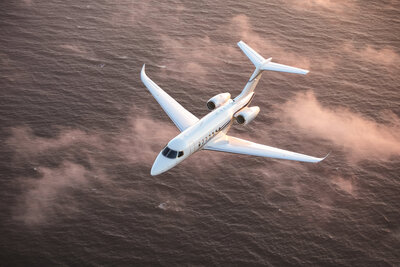
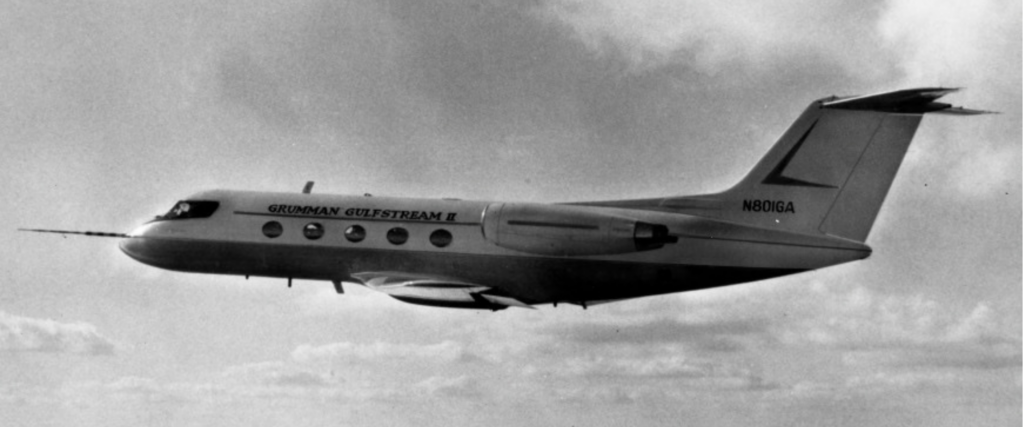
Every large-cabin business jet flying today traces part of its lineage back to one airplane. The Gulfstream II was the first business jet to combine a big, stand-up style cabin with the range to cross an ocean, and in 1968 it proved it by flying nonstop from New Jersey to London. It also gave Savannah, Georgia the factory that still builds Gulfstreams today, and it went on to train every Space Shuttle commander NASA ever flew. Few aircraft have carried that much history in one airframe.
Customers Who Wanted a Jet
By the mid-1960s, Grumman had a hit on its hands with its Gulfstream turboprop, a large, comfortable aircraft that corporate flight departments loved. What those customers wanted next was the same cabin and the same range, with jet speed.
The first generation of small business jets had arrived, but none of them delivered the cabin space and long-range comfort Grumman’s turboprop buyers were used to. Grumman saw a gap at the top of the market and the chance to fill it, as long as it could find the right engine.
That engine turned out to be the Rolls-Royce Spey turbofan. With the Spey available and 30 firm orders in hand, Grumman gave the Gulfstream II its production go-ahead on May 5, 1965.
From Bethpage to Savannah
The prototype made its first flight from Grumman’s Bethpage, New York facility on October 2, 1966, a 52 minute sortie that launched a flight test program involving four aircraft. The FAA awarded the Gulfstream II its type certificate on October 19, 1967.
At the same time, Grumman was making a decision that would shape the company’s future for decades. It separated its civil aircraft business from its military work and moved civilian operations to a new facility in Savannah, Georgia. The building opened in June 1967 and was formally dedicated on September 29, 1967. Gulfstream II production shifted there, and Savannah has been the home of Gulfstream ever since.
Today, Gulfstream remains one of Savannah’s largest employers, and its headquarters and main production line still sit on the same ground where the Gulfstream II first came together.
First Across the Atlantic
The first production Gulfstream II was delivered to National Distillers and Chemical Corporation on December 6, 1967. Five months later, that same aircraft made history.
On May 4, 1968, the Gulfstream II became the first business jet to fly nonstop from the United States to Europe, departing Teterboro, New Jersey and landing at London’s Gatwick Airport. A flight that business travelers now take for granted was, until that day, something no business jet had done.
The achievement turned the Gulfstream II from a comfortable corporate jet into a genuinely intercontinental one, and it set the expectation that a flagship business jet should be able to cross an ocean without stopping for fuel.
What the Gulfstream II Delivered
The Gulfstream II’s numbers explain why it earned its reputation:
- Engines: Two Rolls-Royce Spey 511-8 turbofans, each producing 11,400 pounds of thrust
- Speed: Maximum cruise of Mach 0.85
- Ceiling: 45,000 feet
- Cabin: About 6 feet 1 inch tall and 7 feet 3 inches wide, with typical seating for 10 to 12 passengers
- Maximum takeoff weight: 62,000 pounds
- Extended range: 2,625 nautical miles of range with every seat filled. Optional wingtip fuel tanks added about 400 nautical miles more and became standard equipment starting with serial number 198 in 1976
For corporate flight departments, the combination of cabin, speed, and range was unlike anything else available at the time.
Training Every Shuttle Commander

The Gulfstream II’s most unusual job had nothing to do with business travel. NASA operated four heavily modified Gulfstream IIs as Shuttle Training Aircraft, and they became the airplanes astronauts used to learn how to land the Space Shuttle.
The modifications were extensive:
- The left seat was fitted with Space Shuttle controls and displays, while normal flight controls moved to the right seat for the instructor.
- Windows on the left side were masked to match the view from the shuttle’s cockpit.
- The main landing gear stayed down and the engines ran in reverse thrust in flight, adding enough drag to mimic the shuttle’s steep, unpowered glide.
- The aircraft flew a 20 degree outer glideslope, several times steeper than a normal airliner approach, before transitioning to a shallow final glideslope at 300 feet.
Every shuttle commander practiced at least 1,000 landings in the Shuttle Training Aircraft before a mission, as did each mission’s pilot. The fleet flew from El Paso, Texas, Houston’s Ellington Field, and Kennedy Space Center, and was retired in 2011 when the shuttle program ended. All four aircraft are now preserved, including examples at the U.S. Space and Rocket Center in Huntsville, Alabama, the Texas Air and Space Museum in Amarillo, and the Evergreen Aviation and Space Museum in McMinnville, Oregon.
Owners and Operators
The Gulfstream II quickly became the aircraft of choice for major corporations, and it carried its share of public figures too. Vice President Nelson Rockefeller personally owned one and used it for official travel under the callsign “Executive Two.” The U.S. military and government agencies also operated the type in various roles.
The Aircraft That Built the Gulfstream Name
More than 250 Gulfstream IIs were built over roughly a decade of production. Later in its run, Grumman’s civil business went through a series of ownership changes, and in 1978 the Gulfstream line and the Savannah plant were sold to American Jet Industries, led by entrepreneur Allen Paulson. In 1982, the company was renamed Gulfstream Aerospace Corporation.
The Gulfstream II also led directly to its successor. The Gulfstream III kept the same basic fuselage and added a new, wider wing with winglets, a wing that was later retrofitted to many Gulfstream IIs to create the Gulfstream IIB.
The type’s working life in the U.S. eventually ran into noise rules. Under federal regulations, jets under 75,000 pounds that did not meet Stage 3 noise standards were barred from operating in the contiguous 48 states after December 31, 2015, which ended domestic flying for most unmodified Gulfstream IIs.
Why It Still Matters
Before the Gulfstream II, business jets were fast but compact, and long-range comfort belonged to turboprops and airliners. The Gulfstream II brought those worlds together: a large cabin, jet speed, and true intercontinental range in one purpose-built business aircraft. It made the nonstop ocean crossing a business jet standard, it put Gulfstream in Savannah, and it established the brand as the name in large-cabin business aviation, a position it still holds nearly six decades later.
Contact Holstein Aviation to talk through where today’s business aircraft came from, and where the market is headed next.
Sources: