
Most business jets earn their place in history by being fast, or comfortable, or first. The Dassault Falcon 20 earns its place by being two things at once. It is the aircraft that turned a French fighter manufacturer into a permanent fixture of American business aviation, and it is the aircraft that gave a young entrepreneur named Fred Smith the airframe he needed to build FedEx. Most business jets get one legacy. The Falcon 20 got two.
Why Dassault Built a Business Jet in the First Place
Dassault did not enter the corporate jet market because someone spotted a gap in it. The company got there by way of French government policy.
After World War II, the French government pushed its aviation manufacturers hard to compete with the United States and Great Britain. Aviation was treated as a matter of national industrial standing, not just a business sector to leave alone. By 1960, that push turned into a specific request: the government wanted a multipurpose liaison and trainer aircraft powered by twin turbofan engines.
Marcel Dassault, whose company had already built its name on the Mirage fighter line, saw a way to answer that government requirement and open a second market at the same time. He had his team design an eight to ten seat aircraft that could serve as a military liaison plane for France and also be sold as a corporate jet to private buyers. One airframe, two customers.
That dual purpose thinking is also why the airplane flew as well as it did. Dassault brought the same engineering discipline behind the Mirage into a civil design, at a time when Lockheed and Sabreliner were the established competition and a scrappy new entrant called Learjet was just getting started. The fighter jet pedigree became a selling point Dassault leaned on for decades.
So the honest answer to why Dassault built a business jet is straightforward. The French government asked for a liaison aircraft, and Dassault was smart enough to design one that could also make money in a market almost nobody else had figured out yet.
The Room That Changed Everything
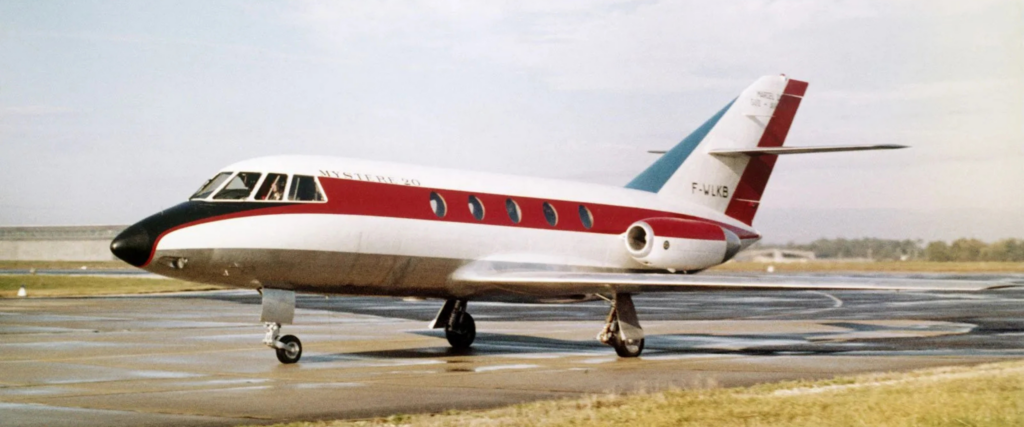
Development started under the name Mystere 20, and the prototype made its first flight on May 4, 1963, out of Bordeaux-Merignac. Dassault had the engineering. What it did not have was any real ability to sell an airplane to American buyers.
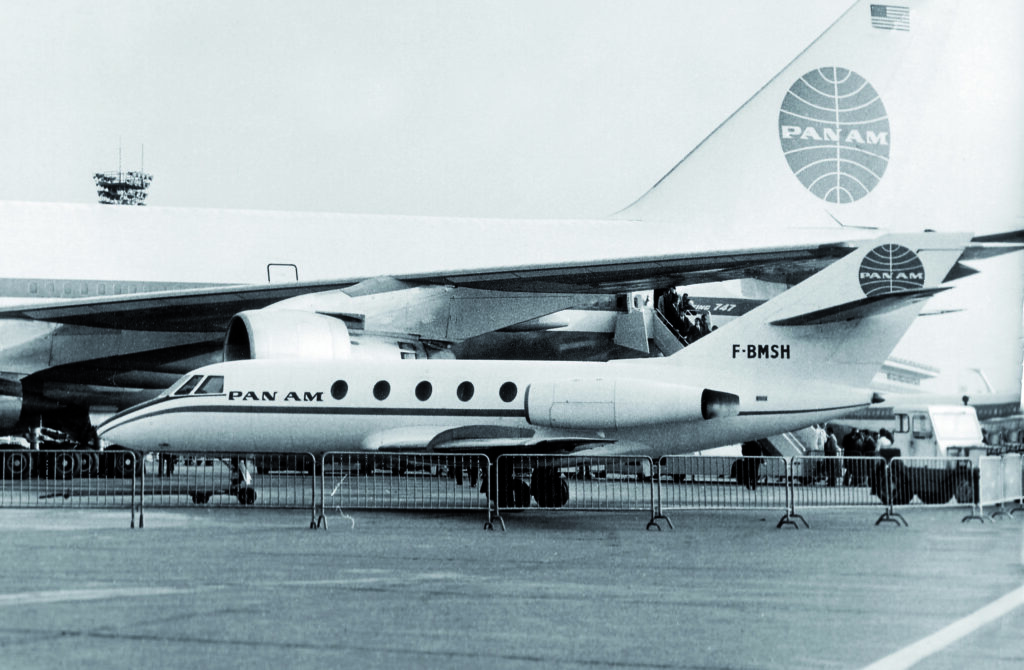
That gap was closed at the 1962 NBAA convention in Pittsburgh, where Dassault put the aircraft in front of the people who mattered most in American aviation. Charles Lindbergh, Pan Am CEO Juan Trippe, and a young executive named Fred Smith, who would later found FedEx, all saw it there.
Lindbergh personally inspected the prototype on behalf of Pan Am’s board and recommended the purchase. Pan Am placed an initial order for 40 aircraft with options for 120 more, and by 1968 its newly formed Business Jets Division had ordered 160. Pan Am’s feedback also shaped the final production design, pushing Dassault to re-engine the aircraft with General Electric CF700 turbofans and enlarge the cabin before deliveries began.
American buyers knew the result as the “Fan Jet Falcon,” which quickly shortened to Falcon 20. Pan Am Business Jets eventually evolved into Dassault Falcon Jet, with its U.S. headquarters today at Teterboro Airport in New Jersey. Every Falcon that Dassault has built since, all the way through the current 6X and 10X, traces its American home back to that partnership.
What the Falcon 20 Actually Delivered
The first production Falcon 20 flew on January 1, 1965, and the aircraft earned both French and US certification by that June. Over roughly 25 years of production, Dassault built around 515 of them, including the improved Falcon 200 variant with more capable Garrett engines and a modernized cockpit.
On paper, the specs held up well against anything else flying in the mid-1960s:
- Twin rear-mounted General Electric CF700 turbofans
- Seating for 8 to 14 passengers
- Top speed of 536 miles per hour
- Range of roughly 2,080 miles
- Service ceiling of 42,000 feet
- No stick pusher or stall-barrier system required, a sign of genuinely favorable handling
Beyond the numbers, the Falcon 20 also went to work in uniform. The US Coast Guard flew 41 of them as the HU-25 Guardian, running high-speed spotter and drug interdiction missions until the last one retired in 2014 after 32 years of service. France, Canada, Australia, and several other countries flew military variants too, and NASA later used former Coast Guard airframes for Arctic research through Operation IceBridge.
The Airplane That Built FedEx
The Falcon 20’s second legacy has nothing to do with executives and everything to do with packages.
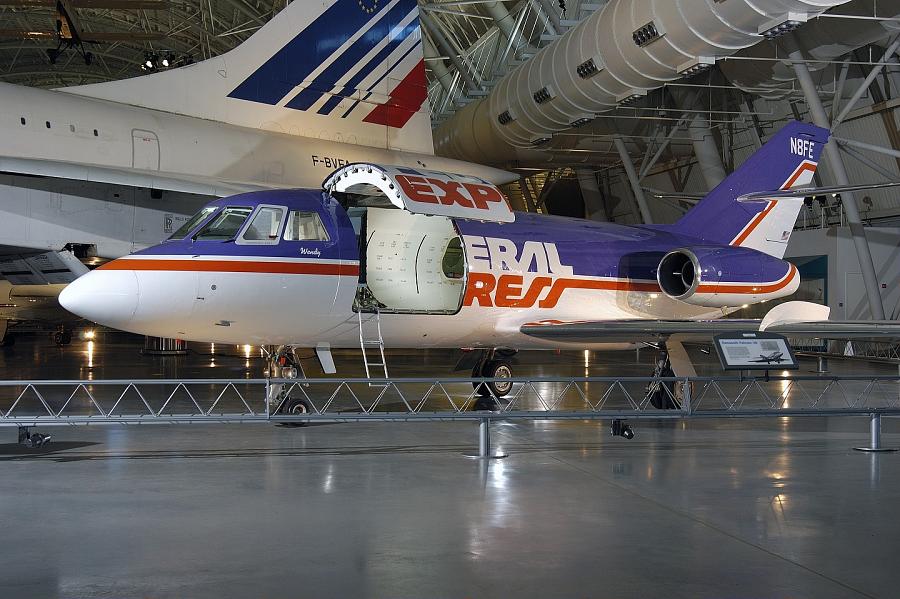
Fred Smith, the same young executive who first saw the aircraft in Pittsburgh in 1962, identified the Falcon 20’s strong fuselage as the ideal platform for cargo conversion. Starting in April 1973, FedEx began flying modified Falcon 20s out of Memphis, fitted with 55 by 74.5 inch cargo doors and reinforced floors to handle package loads instead of passengers.
FedEx eventually operated 33 Falcon 20s at peak, and those aircraft became the literal backbone of the overnight delivery network that changed how the world ships things. The Falcon 20 that carried FedEx’s very first package is preserved today at the Smithsonian’s Udvar-Hazy Center, sitting as proof that a business jet built to fulfill a French military requirement ended up reshaping American commerce from an entirely different angle.
Why It Still Matters
The Falcon 20 is not a household name the way some later business jets became. What it did instead was quietly build two institutions at once. It gave Dassault a real foothold in the American market that the company still holds today, and it gave Fred Smith the airframe that made overnight shipping possible. Few aircraft in any category can claim that kind of dual impact, and fewer still can trace it all back to a French government request for a liaison plane.
Contact Holstein Aviation to talk through the evolution of today’s business jets, and where the market is headed next.