
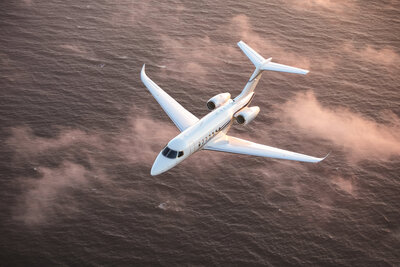

Few aircraft, in any category, carry a legacy that rivals the Learjet 23. It didn’t just introduce a new airplane, it introduced the world to a whole new form of aviation. When the first one rolled out of Wichita in 1964, nobody could have predicted that six decades later, people would still call any small private jet “a Learjet,” whether or not it has anything to do with the company Bill Lear built.
Here’s how a self-taught inventor, a failed Swiss fighter jet, and one enormous bet came together to create it.
The Inventor Behind the Name
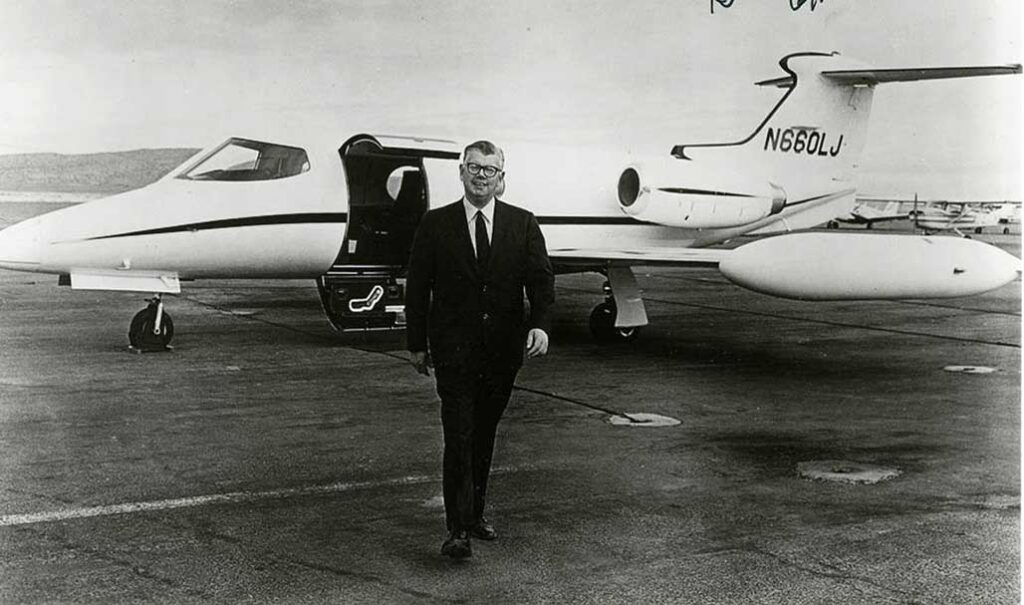
Bill Lear never trained as an aircraft designer. Born in 1902 in Hannibal, Missouri, to a family that split apart while he was young, Lear left school after eighth grade and lied about his age to join the Navy at 16, where he first got exposed to radio and aircraft engineering.
What followed was three decades of relentless invention. In the 1920s, Lear and a partner built one of the first practical car radios and branded it “Motorola,” a name he sold to Paul Galvin’s company, which kept it. He moved on to aircraft avionics next, founding Lear Avia in the 1930s, and by World War II his companies were filling more than $100 million in defense contracts. In 1950, he won the Collier Trophy for a miniaturized autopilot.
Along the way, Lear got into the airplane business itself, buying surplus Lockheed Lodestars and reselling them as executive-fitted “Learstars.” His own board wanted no part of it and tried to shut the project down. Lear kept going anyway, building airplanes had become the challenge he couldn’t walk away from.
A Fighter Jet at the Bottom of Lake Constance
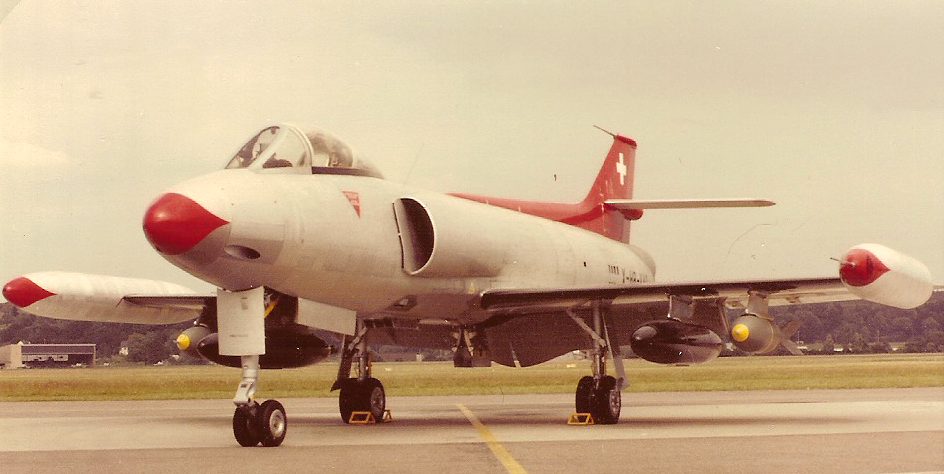
In 1955, Lear moved his family to Switzerland, largely to set up a European subsidiary for his avionics business and to get some distance from a board that had just discovered his aircraft division. While there, he became fascinated with the FFA P-16, a Swiss fighter-bomber prototype meant to replace the Swiss Air Force’s aging jets. The P-16 never made it to production. Only four were built, two ended up at the bottom of Lake Constance after their test pilots ejected during systems failures, and the Swiss press took to calling it “the Swiss Submarine.”
Lear didn’t want the fighter. He saw potential in its wing, a thin, relatively low-aspect-ratio design that combined high-speed performance with sophisticated high-lift devices for short-field operations. He hired the P-16’s chief designer, Hans Studer, to help develop a small business jet through the Swiss American Aviation Corporation, which Lear had established in Switzerland. The result became the SAAC-23. Lear’s own family later disputed exactly how much of the P-16 carried over into the Learjet, but the Model 23 clearly incorporated a modified version of the P-16 wing concept, including elements of its airfoil and multi-spar construction.
From SAAC-23 to Learjet 23
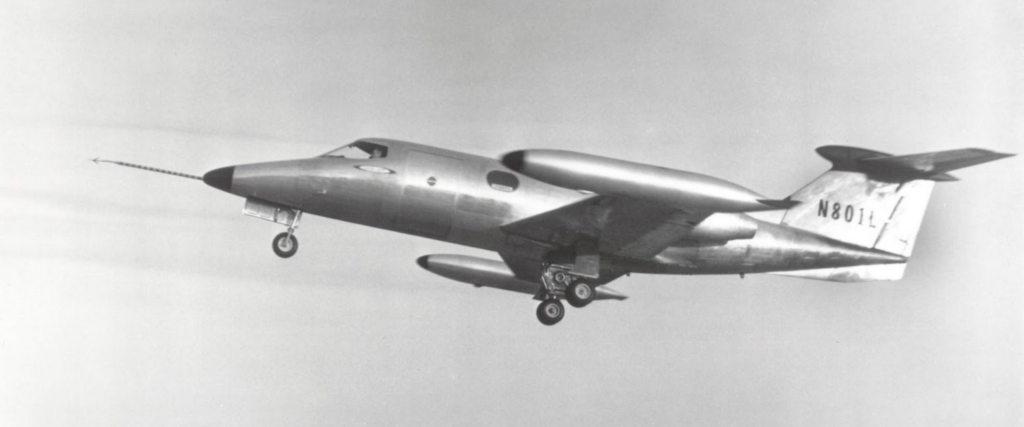
Swiss engineering talent turned out to be better suited to watchmaking than airplane manufacturing, and in 1962 Lear moved the project to Wichita, Kansas, renaming the company Lear Jet Corporation. Production began that February, and the aircraft made its first flight on October 7, 1963.
Lear made an unusual, high-stakes call along the way: rather than build a hand-tooled prototype first, he built his very first airplane directly on production tooling. “With this approach, you’re either very right or very wrong,” he said. During FAA certification testing that June, a pilot forgot to retract the landing spoilers on a touch-and-go, and the airplane went down in a cornfield and burned. Lear collected the insurance check and kept moving. The FAA certified the Learjet 23 that July, weeks later and months ahead of its closest competitor, the Aero Commander 1121 Jet Commander. The first production aircraft was delivered that October.
The Jet That Named Its Own Category
Bill Lear wasn’t just an inventor, he was a relentless promoter, and he had one explicit goal for the Learjet 23: he wanted the name synonymous with the entire idea of a business jet. He pushed to get the airplane in front of the public constantly, including placements in movies and television, so that any time someone saw a small jet, “Learjet” was the word that came to mind.
It worked. Like Kleenex for facial tissue or Scotch tape for adhesive tape, “Learjet” became a genericized trademark that outgrew the brand itself, and the word still shows up in casual conversation today to describe private jets that have nothing to do with the company.
The Numbers Behind the Name
The Learjet 23 backed up the marketing with real performance for 1964. It cruised at roughly 518 miles per hour at 40,000 feet and could hit a top speed of 561 miles per hour, or Mach 0.82, at 24,000 feet, numbers that made it one of the fastest civilian aircraft in the world. Its service ceiling reached 45,000 feet, with a maximum range of about 1,830 miles.
At just over 43 feet long with a 35-foot, 7-inch wingspan, it was small by today’s standards, seating two crew and four to six passengers. That size was the point: speed and simplicity, priced within reach of a successful individual owner rather than just a corporate flight department. Learjet built 101 of them before ending the run in 1966 to move on to the improved Learjet 24 and 25.
Frank Sinatra’s Christina II
The Learjet 23’s celebrity ownership history starts with Frank Sinatra, who took delivery of one of the first production aircraft in 1965 and named it Christina II, after his youngest daughter. Over the next two years, it logged around 1,500 hours flying him, his Rat Pack circle, and a rotating cast of showbiz friends, including Elvis Presley, between Las Vegas, Palm Springs, and film locations.
Sinatra sold the aircraft in 1967 and moved up to a Gulfstream II, but the image stuck. A Learjet loaded with Rat Pack members touching down in Las Vegas is one of the defining pictures of 1960s American glamour, and it did as much as any advertisement to cement the Learjet name as a symbol of speed, money, and status.
A Rough Start for a New Category
The Learjet 23’s early safety record was genuinely difficult. Of the 101 built, 27 were eventually lost or damaged beyond repair in accidents, the most recent in 2008. As of 2025, only a single Learjet 23 remains airworthy.
Some of that record reflects the era rather than the airplane itself. Business jet aviation was brand new, and jet training and operating standards hadn’t caught up to piston-era norms yet. If anything, the early accidents fed the mystique rather than damaging it, adding to the outlaw glamour of a jet that was fast, exclusive, and a little dangerous.
Why It Still Matters
The Learjet 23 proved a market existed for a small, fast, owner-operated jet built specifically for corporate and personal travel, one that could be marketed directly to individuals, not just sold to flight departments. Every light jet built since, from the Citation I through today’s Phenom 300 and CJ4, owes something to the category it created. Sixty years later, “Learjet” is still the word many people reach for when they see a private jet overhead, and that’s a legacy very few aircraft in any category can claim.
Contact Holstein Aviation to talk through where today’s business jets came from, and where the market is headed next.