

What Is Emergency Autoland?
Emergency autoland is one of the most significant safety advances in private aviation in the last decade. If you are shopping for a private jet or turboprop, understanding which platforms include this technology and how it works is worth your time. Here is what you need to know.
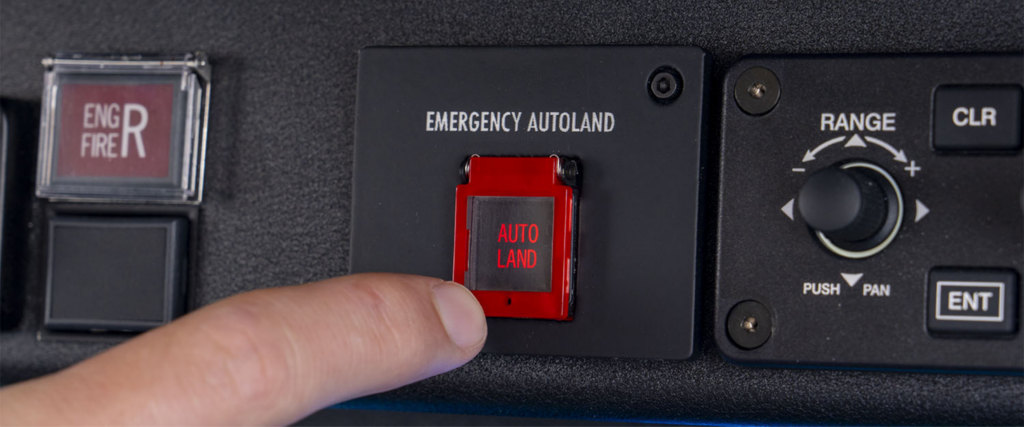
Emergency autoland is a system that can fly and land an aircraft automatically if the pilot becomes incapacitated. It does not require a pilot or a passenger to have any flying experience to activate it. In most implementations, a passenger simply presses a dedicated button on the avionics panel, and the system takes over.
From that point, the aircraft handles everything: it identifies the nearest suitable airport, reroutes the flight plan, coordinates with air traffic control, manages the descent, configures the aircraft for landing, and touches down on the runway. The system even controls the throttle during the landing rollout.
Garmin developed the technology under its Autoland system, which is part of its broader Autonomi suite of autonomous flight capabilities. The FAA first certified it in 2020 on the Piper M600 SLS, making that aircraft the first in the world to receive approval for a fully autonomous emergency landing system.
Which Aircraft Have It?
Emergency autoland is currently most common in single-engine turboprops and light jets. Here is where the technology is certified, announced, or available:
Piper M600 SLS: The first aircraft certified with Garmin Autoland. The SLS trim level was built specifically around this technology. It remains one of the most compelling safety stories in the single-engine turboprop category.
Piper M700 Fury: Piper’s successor to the M600 includes Autoland as standard. The Fury takes the M600 platform forward with updated performance and retains the same autonomous landing capability.
Daher TBM 940 and TBM 960: Both TBM variants include Garmin Autoland. The TBM 940 was one of the early adopters, and the 960 carries it forward as the current production model.
Beechcraft Denali: Textron Aviation’s new single-engine turboprop is expected to include Garmin Autoland as part of its G3000-based avionics suite, making it one of the most capable and safety-forward turboprops entering the market.
Cirrus Vision Jet (G2+): The Vision Jet became the first jet-powered aircraft to be certified with Garmin Autoland. Combined with the Cirrus Airframe Parachute System (CAPS), the Vision Jet offers an unusual depth of redundant safety options.
Citation M2 Gen3: Cessna has announced Garmin Emergency Autoland for the M2 Gen3, bringing the technology into the light jet segment in a meaningful way.
HondaJet Elite II: In February 2026, the Elite II became the first twinjet to receive FAA approval for Garmin Emergency Autoland. Honda Aircraft completed certification flight testing in October 2025 before receiving FAA approval, and the system works the same way as on other Garmin-equipped platforms: passengers press a button, and the aircraft handles everything from ATC communication to touchdown.
How It Actually Works
The passenger-facing experience is deliberately simple. When activated, the system takes over completely. Here is what happens:
A passenger activates it by pressing a dedicated button on the avionics panel – no flying experience required. The system can also trigger automatically if the pilot becomes unresponsive for an extended period.
The aircraft communicates with ATC using a specific transponder code and automated radio calls to alert controllers that the aircraft is operating autonomously. Controllers clear the path.
The system selects the best airport by evaluating multiple options simultaneously, weighing runway length, weather conditions, fuel remaining, and approach procedures. It runs a real-time calculation and picks the best available landing site.
It flies the approach and lands, managing the descent, configuring the aircraft, and controlling the throttle through the landing rollout.
What About Larger Jets?
This is the honest answer for buyers shopping in the midsize, super-midsize, or large cabin large-cabin categories: emergency autoland is not widely available yet at those levels.
The reason comes down to how redundancy is built into each category. Larger jets require two pilots by regulation, meaning there is always a second crew member trained and qualified to take over if the other is incapacitated. That built-in human redundancy is the safety net. Single-pilot jets have no such backup, which is precisely why emergency autoland is so valuable in that segment. The technology fills the gap that a second crew member would otherwise cover.
FAA certification for autonomous landing on multi-crew jets also involves a significantly more complex regulatory process, and the assumption in larger aircraft categories is that two pilots are on board, which changes the calculus considerably.
That does not mean the technology will not arrive in larger platforms. Garmin and the major airframe manufacturers are actively developing the path forward. But if autoland is a priority for you today, your realistic options are in the single-engine turboprop and light jet segments.
Why It Matters for Buyers
The most common objection to emergency autoland is that buyers in this space are healthy and fit and unlikely to need it. That may be true. But there are several reasons it still matters:
It is not just about incapacitation. The value of autoland is what it represents: a fundamental shift in how avionics can serve as a true safety net for anyone on board.
It changes the conversation for families. It is the difference between passengers being completely helpless in an emergency and having a concrete option to reach the ground safely.
It matters for resale. Aircraft equipped with Autoland have a clear differentiator in the used market, and that conversation is only going to get louder as more platforms adopt the technology.
The Bottom Line
Emergency autoland is no longer a concept. It is certified, it works, and it is available today on several popular single-engine turboprops and light jets. If you are evaluating a Piper Fury, a TBM 960, a HondaJet Elite II, or a Citation M2 Gen3, autoland is already part of the package or announced for the platform. For buyers prioritizing safety technology, these platforms deserve serious consideration.
If you want help evaluating which aircraft best fits your mission and priorities, the team at Holstein Aviation is here to help. Contact us here.